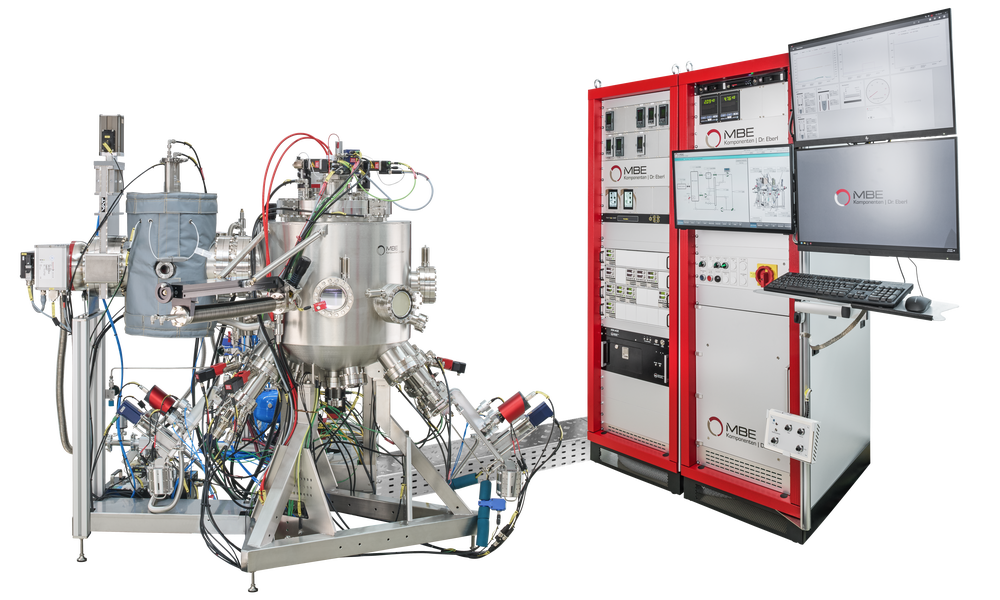
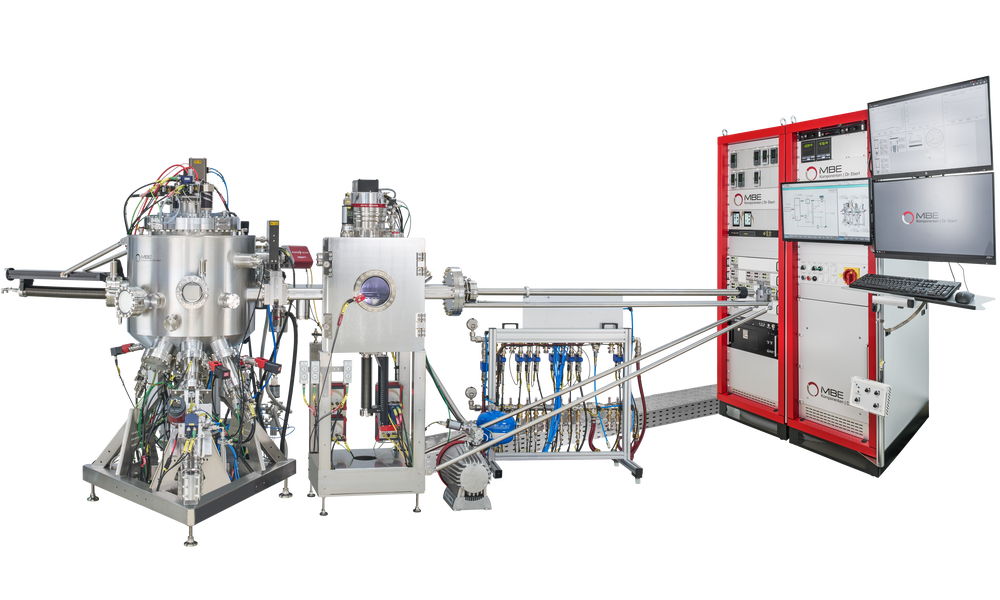
OCTOPLUS-BTO 600
- Dedicated system for functional perovskite epitaxy on silicon (strontium titanate STO, barium titanate BTO)
- up to 12 source ports
- source options for hybrid MBE
- best-in class deposition configuration for high material useage and long campaign times
- water cooled chamber version availiable that does not require any liquid nitrogen during operation
- dedicated processes such as template oxides (STO/BTO) for silicon integration on wafers up to 300mm
- Oxygen-resistant SiC substrate heater
- In-situ characterization capability
- Professional support by PhD MBE experts
General Information
Thin barium titanate (BTO) layers on silicon (Si) are of great interest for integrated photonics due to its very strong electro-optical effect. Si dominates the electronic semiconductor industry and also offers significant advantages in integrated photonics. The Si manufacturing infrastructure with 300mm wafers allows direct compatibility with existing process lines. Although Si has inherent limitations in the production of photonic components, this can be overcome by integration with functional materials. The Octoplus BTO features a dedicated design for epitaxial growth of STO template layers as well as BTO layers. The Pockels effect of BTO surpasses the currently used lithium niobate (LN) by more than an order of magnitude. Recent studies have demonstrated the exceptional performance of BTO-based modulators, which enable significantly smaller components and thus a much higher integration density compared to LN.
Applications of BTO to Si include: ultrafast data communication, photonic quantum computers, waveguides, and energy-efficient modulators on Si. The Octoplus BTO system can be equipped with sources for hybrid MBE that allow substantally higher growth rates as well as longer campaign times and thereby overcome one of the challenges in mass-producing BTO layers on large 300mm Si wafers on an industrial scale.
In the hybrid MBE approach, elemental strontium and barium from thermal effusion cells are evaporated, along with the metal-organic precursor molecule titanium tetraisopropoxide (TTIP). TTIP delivers titanium and oxygen simultaneously. The decisive advantage lies in the self-regulating growth kinetics: under optimized conditions, excess TTIP molecules desorb from the surface, automatically ensuring the ideal stoichiometry of the layer. The performance of the hybrid MBE has been demonstrated in numerous studies.


